
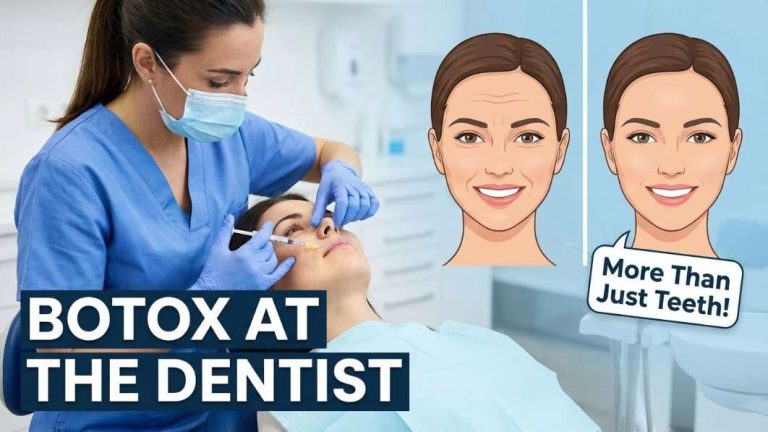
When most people think about getting Botox, a dentist’s office probably isn’t the first place that comes to mind. But that’s changing fast. A growing number of patients are discovering that their dentist may actually be one of the most qualified professionals to administer Botox, and they’re booking appointments accordingly. If you’ve been curious about facial aesthetic treatments and wondering where to get them, your dentist’s office deserves a serious look. [1]
According to the American Society of Plastic Surgeons, minimally invasive treatments like Botox remained highly sought after in 2024, experiencing a 1.5% increase over the previous year. What’s less well known is the growing number of these injections now being performed by dentists rather than dermatologists or med spa practitioners. The dental aesthetics market is expanding rapidly, growing at approximately 10% annually. [2, 3]
So what’s driving this shift? It comes down to anatomy, training, and trust.
Why Are Dentists Offering Botox?
Dentistry has always been about more than just teeth. Dentists are specialists in the entire oral and maxillofacial region, which includes the muscles, nerves, and tissues of the face and jaw. Botox works by temporarily relaxing specific facial muscles, and it turns out that the professionals who spend their entire careers working with those muscles are extremely well-suited to inject them. [4]
This isn’t a fringe trend. Over one million Botox procedures have been performed by dentists in the U.S., according to the American Academy of Procedural Medicine (AAOPM). Universities like the University of Florida College of Dentistry and organizations like the Oklahoma Dental Association now offer formal botulinum toxin training programs specifically designed for dental professionals. [3, 8, 9]
What Makes Dentists Uniquely Qualified for Botox Injections?
This is where the case for dental Botox gets compelling. Dentists complete four years of doctoral-level education focused heavily on the anatomy of the head, face, and neck. That includes detailed study of facial muscles, nerve pathways, blood vessel locations, and the way all of these structures interact when you chew, speak, or make expressions. [10, 11]
The first two years of dental school cover anatomy, physiology, histology, neuroscience, and pharmacology, followed by advanced courses in head and neck anatomy, oral and maxillofacial pathology, and oral radiology. At some dental schools, first- and second-year students take the same foundational science courses alongside medical students. The key difference is that dental education focuses specifically on the head, face, and neck, which is exactly the region where Botox injections take place. [12, 13]
Beyond classroom training, there’s the matter of hands-on injection experience. As the AAOPM notes, years of administering local anesthesia, understanding trigeminal nerve distribution, and working in the perioral region make dentists exceptionally qualified for facial injectables. They know where the nerves are, where the blood vessels run, and how to place a needle with accuracy in the delicate tissues of the face. That practical experience translates directly to Botox administration, where precision determines whether you get natural-looking results or an uneven outcome. [4]
Curious whether dental Botox could be the right fit for your aesthetic or jaw-related concerns? Our team is here to walk you through your options.
How Does Getting Botox at the Dentist Compare to a Med Spa?
Both dentists and med spas can deliver good Botox results when the injector is well-trained. But there are some meaningful differences worth understanding before you book.
Clinical Training and Oversight
Dentists hold doctoral degrees (DDS or DMD) and are licensed medical professionals who are regulated by state dental boards. They carry malpractice insurance, maintain continuing education requirements, and operate under strict clinical standards. At a med spa, the person injecting your Botox might be a physician, a nurse practitioner, a registered nurse, or in some cases, an aesthetician working under a physician’s supervision. The level of training varies widely from one med spa to the next, and in some cases, injectors may have completed only a brief certification course before offering services. [14, 15]
Understanding of Facial Anatomy
Dentists spend their education focused specifically on the oral and maxillofacial region. That specialized knowledge means they understand how each facial muscle connects and interacts, which is critical for achieving balanced, natural results. A dental Botox provider who sees the full picture of how your jaw, lips, cheeks, and forehead muscles work together can make more informed decisions about injection placement and dosing. [11]
Safety and Emergency Preparedness
Dental offices are clinical medical environments equipped with emergency medications, oxygen, and monitoring equipment. The ADA recommends that all dental practices maintain emergency drug kits and that clinical staff be trained in basic life support. If a rare adverse reaction occurs during a Botox injection, a dental office is prepared to manage it immediately. Dental offices also operate under strict sterilization and infection control protocols for procedures like surgeries and extractions, which carries over to injectable treatments. [15, 16, 17]
Convenience and Combined Appointments
Many patients appreciate the ability to combine their Botox treatment with a routine dental visit. Instead of scheduling a separate appointment at a med spa, you can address cosmetic goals during the same visit where you’re getting a cleaning or checkup. This saves time and keeps your facial care coordinated with a provider who already knows your oral and facial health history.
Skip the second appointment and bundle your aesthetic care with the team that already knows your smile.
Can Botox at the Dentist Treat More Than Wrinkles?
One of the biggest advantages of getting Botox from a dentist is access to therapeutic applications that most med spas simply don’t offer. While cosmetic Botox for frown lines, crow’s feet, and forehead wrinkles gets most of the attention, dentists are also using Botox to address real functional problems. [18, 19]
TMJ Disorders and Jaw Pain
If you experience chronic jaw pain, clicking, or difficulty opening your mouth, you may be dealing with a temporomandibular joint (TMJ) disorder. Botox injected into the overactive jaw muscles can reduce tension and provide significant pain relief. A 2024 systematic review published in Dentistry Journal found that botulinum toxin may provide benefits for managing TMJ symptoms associated with bruxism, with one study showing pain scores dropping from 7.1 before treatment to 0.2 at the six-month mark. If you’ve been dealing with TMJ-related headaches, this treatment may be worth discussing with your dentist. [20]
Teeth Grinding (Bruxism)
Bruxism, the involuntary grinding or clenching of teeth, can cause worn enamel, jaw soreness, headaches, and even cracked teeth. Botox injections into the masseter muscles can reduce the intensity of grinding by relaxing the muscles responsible for clenching. Research shows that Botox can decrease bruxism events from an average of about 5 episodes per hour to fewer than 2, according to the same systematic review. [20, 22]
Gummy Smile Correction
Some patients feel self-conscious about showing too much gum tissue when they smile. Botox can be carefully injected into the muscles that pull the upper lip too high, resulting in a more balanced smile line without surgery. This is a treatment that requires precise knowledge of lip and facial muscle anatomy, which is exactly what dentists are trained in. [23]
Chronic Headaches Related to Jaw Tension
Many headaches originate from tension in the jaw and facial muscles, particularly in patients who clench or grind their teeth. Botox can help by reducing the chronic muscle tension that triggers these headaches. This is separate from the FDA-approved use of Botox for chronic migraines, though patients with TMJ disorders often experience overlapping symptoms. [4, 18]
Is Dental Botox Safe?
Botox has been FDA-approved since 2002 for cosmetic use and has a well-established safety profile across millions of treatments. Englewood Dental offers BOTOX and Restylane treatments as part of our comprehensive facial aesthetics services. When administered by a trained professional, serious complications are rare. [11]
The most common side effects are mild and temporary. According to the Cleveland Clinic, they include slight bruising at the injection site, minor swelling, and occasional headache. These typically resolve on their own within a day or two. Serious adverse events, such as allergic reactions or unintended muscle weakness, are uncommon and are more likely to occur when Botox is administered by an inexperienced injector. [21]
Getting Botox in a dental office adds an extra layer of safety because you’re in a regulated clinical environment. Your dentist is trained to recognize and respond to any complications immediately, which provides peace of mind that may not come with every med spa experience.
How to Know If Dental Botox Is Right for You
Dental Botox may be a good fit if you’re looking for cosmetic wrinkle reduction and want it done by a provider with deep facial anatomy expertise. It’s also worth considering if you deal with TMJ pain, teeth grinding, jaw tension headaches, or a gummy smile, since your dentist can address both functional and aesthetic concerns in one visit.
The best way to find out is to schedule a consultation. At Englewood Dental, our team can evaluate your needs and recommend a treatment plan tailored to your goals, whether that’s smoothing out forehead lines, relieving jaw pain, or both.
Ready to see whether Botox at the dentist is the right fit for you? We’d love to meet you.
References
- https://englewooddental.com/blog/a-simple-guide-to-facial-aesthetic-treatment/
- https://www.plasticsurgery.org/news/press-releases/interest-in-aesthetic-health-remained-consistent-despite-economic-uncertainty-in-2024-according-to-new-report-from-american-society-of-plastic-surgeons
- https://aaopm.com/blog/botox-certification-for-dentists-requirements-training-courses-2025/
- https://aaopm.com/courses/botox-training-dentists/
- https://engage.ada.org/courses/403/view
- https://www.gertsberg.com/2014/02/new-jersey-dentists-can-administer-botox/
- https://dentox.com/state-by-state-dental-botox-regulations/
- https://ce.dental.ufl.edu/courses/restorative-and-esthetic-dentistry-courses/botulinum-toxin/
- https://www.okda.org/botox/
- https://www.leveragerx.com/blog/do-dentists-go-to-medical-school/
- https://englewooddental.com/treatments/botox-restylane/
- https://forums.studentdoctor.net/threads/dental-school-the-same-as-medical-school-for-yr1-and-yr2.237514/
- https://www.frontiersin.org/journals/dental-medicine/articles/10.3389/fdmed.2025.1596610/full
- https://aaopm.com/blog/who-can-legally-inject-botox-professional-qualifications-healthcare-providers/
- https://www.cdc.gov/dental-infection-control/hcp/summary/sterilization-disinfection.html
- https://www.ada.org/resources/ada-library/oral-health-topics/medical-emergencies-in-the-dental-office
- https://www.healthfirst.com/articles/guidelines-for-emergency-medical-kits-for-dental-offices/
- https://pmc.ncbi.nlm.nih.gov/articles/PMC4672850/
- https://www.colgate.com/en-us/oral-health/bruxism/botox-for-bruxism-learn-whats-right-for-you
- https://pmc.ncbi.nlm.nih.gov/articles/PMC11203296/
- https://pmc.ncbi.nlm.nih.gov/articles/PMC9719743/
- https://pmc.ncbi.nlm.nih.gov/articles/PMC9941039/